Sunday
18th Oct 2026
Dhivehi Edition
Ministry of Fisheries, Agriculture and Marine Resources
Maldives opens parasitoid-rearing center at Hanimaadhoo
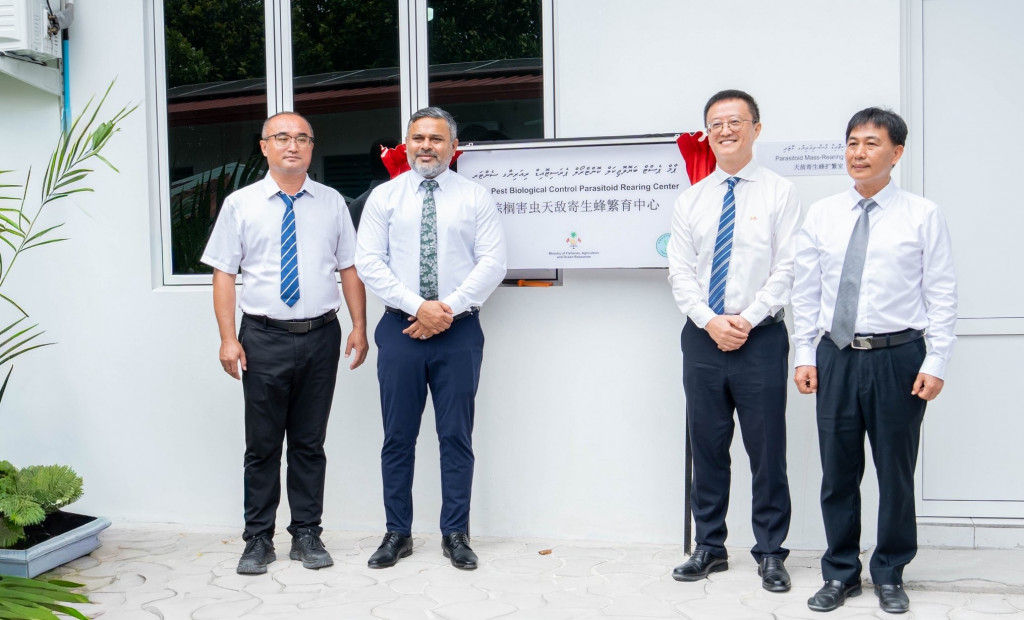
Photo: Ministry
The Maldives has officially opened a specialized facility to breed parasitoid insects that attack coconut pests, aiming to protect the country’s vital coconut palms through environmentally friendly methods.
The Palm Pest Biological Control Parasitoid Rearing Center, located at the Hanimaadhoo Agriculture Center, was inaugurated by Fisheries and Agriculture Minister Ahmed Shiyam and Chinese Ambassador Kong Xianhua.
The center forms a key part of the Maldives Coconut Tree Pest Control Assistance Project, a joint initiative between the Maldivian government and China. An agreement underpinning the project was signed on July 14, 2025, between the Maldives government and China’s Ministry of Commerce.
Officials said the facility’s primary goal is to identify diseases and harmful pests affecting coconut trees and establish a sustainable control system. Beneficial parasitoids will be reared and released into affected areas. The center is expected to produce more than 100,000 parasitoids daily.
The coconut hispid beetle was first detected in the Maldives in 1999 at Sun Island Resort. Subsequent control efforts, including a project supported in 2003, have faced ongoing challenges. Authorities hope the new center will deliver a more lasting solution.
Chinese experts from the Chinese Academy of Tropical Agricultural Sciences have also conducted training at Hanimaadhoo on biological pest control techniques and plant disease management.
In parallel, the government is strengthening rules for importing trees and enforcing quarantine standards. Officials expressed optimism that the center will support broader gains for Maldivian agriculture and the economy.