Sunday
29th Nov 2026
Dhivehi Edition
Politics
Fragmented Initiatives to Methodical Development: Reflections from CPC’s Systematic Approach
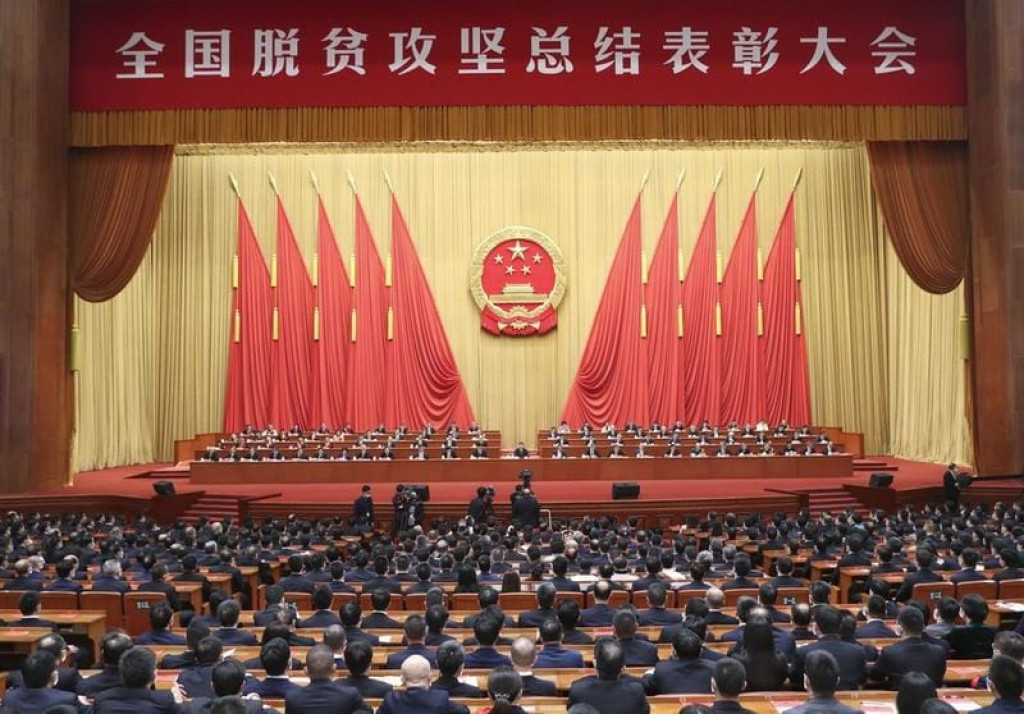
A grand gathering is held to mark the nation's poverty alleviation accomplishments and honor model poverty fighters at the Great Hall of the People in Beijing, capital of China, Feb. 25, 2021. (Xinhua/Ding Lin)
The continuous endeavor towards action by Political Parties, to enhance the lives of their members or the lives of the citizens of their constituencies, is an ongoing effort that is a core principle to the justification to form political parties, and a crux to the reasoning towards joining political parties. The real dilemma arises during the stages of action, that begins after the effort towards getting members onboard to the party where all interested are enrolled. The services that a party brings to the citizens are what remains a legacy and a beacon for new members to join. This paper will focus on exploring the role of political parties to pursue theoretical and practical innovation to play a leading role in addressing development challenges such as poverty reduction.
The principles of Political Parties and their formation may vary contextually. However, the conventional definition of a political party encompasses common aspects. A political party is an organized body of people who advocate a set of agreed principles and policies on political and general matters, and who through peaceful and constitutional means, seek to capture political power so to put them into practice (Arora N.D. 2008). Among political scientists, the existence of free and fair elections on a regular basis is considered the minimal condition for a democracy or democratic regime (Dahl 1971; Diamond 1995). A political party is defined as a political group that is officially recognized as being part of the electoral process and who can support (put forth) candidates for elections on a regular basis (Sartori 1976). These views need to evolve contextually and ensure that the ideas and manifestos of the parties are implemented to reflect development when political parties win elections and spend time governing.
One of the most recognized contemporary political theorists, Giovanni Sartori, defined the party system as a system of interactions resulting from competition between parties (Sartori, 1976). The said competition instead of merely competing for victory in elections, should also focus on competing for successful implementation of national development milestones.
Unlike textbook definitions, the harsh reality on ground is very dynamic in all contexts. Many countries are struggling to balance the needs of the nation and the needs voiced by people. Sometimes this may not be the same as people’s understanding of their needs are limited or reflective of their level of exposure to the concept of development and their exposure to the means and ways to formulate and envision national development. Thus, it is important to address the issue based on the contextual level of participation by the citizens in development.
Small island states like Maldives struggle with this dilemma too. Since gaining independence in 1965, the Maldives comprised of one capital island and about 190 islands. The focus of development was centralized and island development focused on establishing basic amenities and services. While the capital was considered the hub for development. However, over the past, multiple regimes have ruled the island nation and efforts on identifying and implementing economic zones and development zones and hubs have been attempted yet not fruitful due to the change in definition and scope of the zones and hubs. Early attempts focused on making several industrial zones on large and comparatively heavily populated islands or island clusters, such as Seenu atoll and Laamu atoll (World bank 1983). In the early 1900’s the development agenda was tunnel focused on the tourism resort sector development and atoll capitals were hubs of local development in the atolls. The development of these core services like education, health and security has been undertaken in silo at different islands when and where the reigning governments see fit. The role of a parties to assess the needs of the people and serve the public to empower them is largely a gap still in Maldives.
The Chinese proverb 大处着眼 (dà chù zhuó yǎn) which translates to “Look at the whole situation and focus on the big goal” is a well-rounded expression to sum the approach taken by China in the endeavor to utilize the party to strengthen national development.
A political party guided by sound theory and armed with a profound grasp of the laws governing its own development, possesses the clarity, resolve and momentum needed to navigate the complexities of the times. When we look at China we see evidence of how party can act as a tool for development. Since the 18th CPC National Congress in 2012, general secretary of the CPC Central Committee, Xi Jinping, has put forward a series of new ideas, new thinking, and new strategies for governing and strengthening the Party in response to the major questions of the times (XINHUA 2026). These efforts are seen to be reaping their fruits by the surgical responses by the party, through strengthened and organized party activities to address the issues of extreme poverty. Over an eight-year period, nearly 100 million people have been lifted out of poverty and by 2021China had achieved the goal of eliminating extreme poverty (BBC 2026).
The unabated participation of the grass root level and county level Party representatives in identifying, planning and implementing a holistic model, guided by the party leadership, to empower the poverty-stricken populations were key to this success. The capacity building of party representatives and equipping them with necessary knowledge and tools has made them the vessels for the vision by the party leadership and it trickles down to the citizens via the party members and supplements the national development effort. There remain lessons to many countries, from the central role of Party building in China's governance and modernization drive. Disorganized and unmethodical parties are prone to weaknesses in implementing planned policies and decisions and repetitive regimes of nascent parties become a huge barrier for countries in achieving sustainable and holistic development.
Written by: Ismail Azzam Wajeeh, Project Manager at The Maldives National University (MNU). Previously served as Managing Director of Aasandha Company Limited and Chief Executive Officer of the National Social Protection Agency (NSPA).