Sunday
18th Oct 2026
Dhivehi Edition
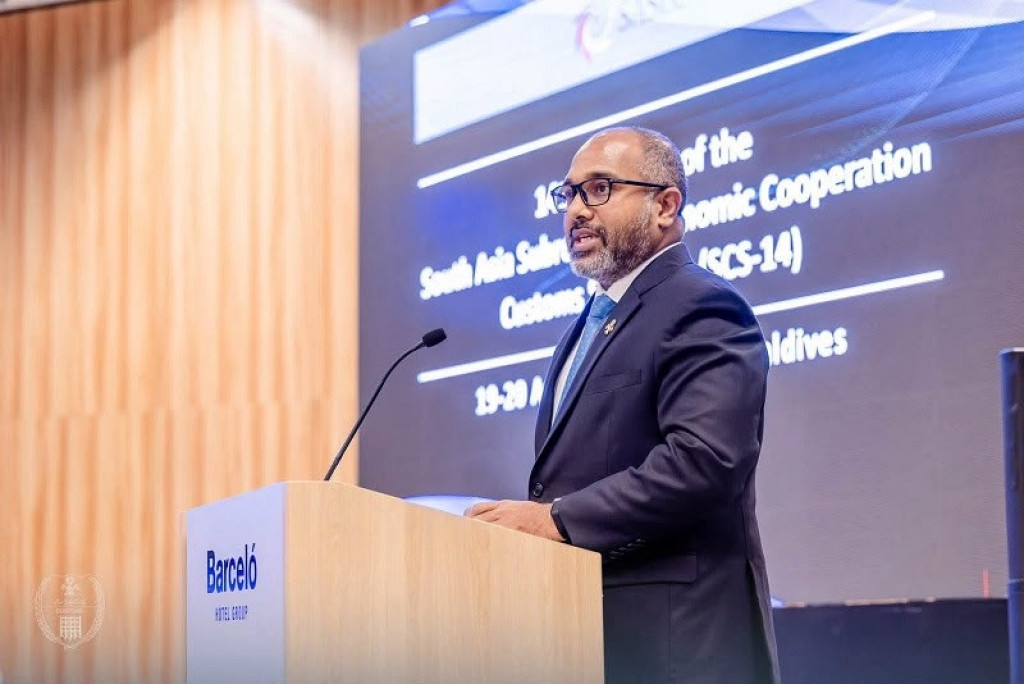
Photo: Foreign Ministry
Homeland Security and Technology Minister Ali Ihusan has said the role of customs administrations has expanded beyond traditional revenue collection and border control, with greater integration of systems, information and institutions needed to strengthen regional connectivity.
Ihusan made the remarks while speaking at the 14th meeting of the South Asia Subregional Economic Cooperation (SASEC) Customs Subgroup.
He said customs procedures and border facilities are being modernised, while investment in digital connectivity is increasing to support regional trade.
However, Ihusan stressed that physical infrastructure alone cannot establish seamless connectivity, noting that the benefits of a modern port can be undermined if goods are delayed by inefficient procedures.
“A regional economic corridor cannot function effectively if information stops at national borders,” Ihusan said, adding that the next stage of regional connectivity should focus not only on linking physical infrastructure, but also on connecting systems, information and institutions.
He said this places customs authorities at the centre of broader economic objectives, noting that their responsibilities today are considerably wider than their traditional functions.
Ihusan also highlighted the role of technology in achieving these objectives, pointing to digital customs systems, the National Single Window, electronic documentation, advance information, automated risk management and data analytics as tools that could transform the movement of goods across borders.
“Digitalisation is not merely converting paper forms into electronic formats,” Ihusan said, stressing the need to redesign processes, remove unnecessary procedures, connect government agencies and enable information to be shared before goods arrive.
The meeting was held from May 19 to 20, with representatives from Bangladesh, Bhutan, Nepal, India and Sri Lanka taking part. The forum brings together customs authorities from the region to strengthen cooperation, facilitate legitimate trade and promote harmonised approaches to customs administration.
As the host country for this year’s meeting, Maldives Customs Service Commissioner General Fathimath Dhiyana served as chairperson of the meeting.