Wednesday
18th Nov 2026
Dhivehi Edition
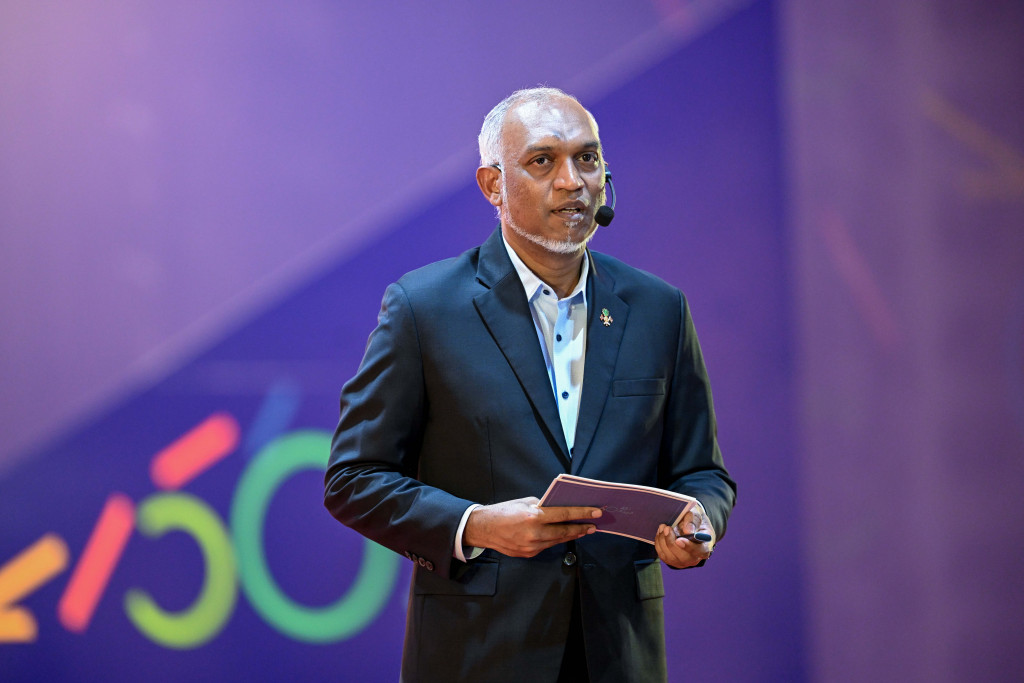
President Dr. Mohamed Muizzu, Photo: TMJ
President Dr. Mohamed Muizzu has stated that he will not hesitate to pursue any decision that is beneficial and sincere to the nation, regardless of how unpopular it might appear to the public. He made the remarks while addressing an official gathering marking the third anniversary of his administration.
Speaking at the ceremony, the President noted that while some decisions taken by the government may temporarily be viewed as unpopular, they are made for the sake and well-being of future generations. He cited the prohibition of vaping and the implementation of a generational smoking ban as examples. In addition, the President noted that when deciding to ban Israeli passports, reservations were raised by sections of the tourism sector, yet the decision was made prioritizing the national interest.
"If something is beneficial to the nation, no matter how unpopular it is, with sincere intentions for the country, I will pursue it God willing," President Muizzu said, adding that he will prioritize the nation above all else without regard for political labels.
Turning to the education sector, President Muizzu said that when his administration assumed office, only 37 percent of students completed O-levels and advanced to A-levels, an enrollment figure that has risen to 46 percent through interventions over the past three years. He further highlighted the establishment of a dedicated vocational school to expand vocational education, where students are currently receiving training in disciplines such as architectural design and engineering.
Reflecting on state spending on higher education, the President revealed that MVR 2.6 billion has been expended over the past three years through scholarships, the free first-degree scheme, and student loans. Higher education opportunities have been facilitated for 11,000 eligible students without leaving anyone behind, he said.
The beneficiaries include 502 medical students, 451 studying engineering, 634 pursuing nursing, 672 in teacher training, 307 across therapy and counseling disciplines, and 920 studying accounting. Furthermore, higher education facility projects have been launched across 21 islands to facilitate decentralized study opportunities in the atolls.
Emphasizing that students pursuing higher education at the state's expense must return to serve their homeland, President Muizzu stated that policies have now been reformed to recover all state expenditure from any student who fails to return to the Maldives upon completion without an acceptable justification.